This eBook is available at all your favorite online bookstores for $0.99
Saturday, August 16, 2014
Genealogy
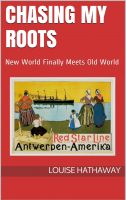
Do you love genealogy? If so, then this story is for you. I am the grand-daughter of a Belgian immigrant who came to America in 1910, and my book describes my efforts to find and reunite with my family in Belgium after a breakdown in communication for twenty-five years. When I made a pilgrimage to meet my relatives in the old world, they pulled out all the stops and treated me like a movie star. The second part of this book is about my father’s family. His family stories include Quakers, buried treasures of gold coins, fighting Indians, homesteading, and owning slaves.

Thursday, August 14, 2014
Thomas Wolfe
Does anyone read Thomas Wolfe anymore? Apparently, yes. A short time ago, I put together this essay as an eBook and it's been selling surprising well. I wonder what is making people buy this little literary essay. Is it the provocative title? Do people see "sluts" and "deep-breasted" in one title and say, "That's the one for me?" Or, do people still read Thomas Wolfe? I hope it's the later. He is one of my all-time favorites. In 1991, I made a pilgrimage to Ashville, North Carolina to go to a Thomas Wolfe festival and this is what I wrote after my trip. I had a chance to meet his nephew, who was the only family member still alive at the time who remembered and spoke with the famous writer. It was quite the thrill for this English major.
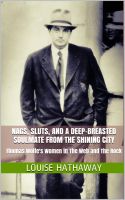
This eBook (with pictures) is available at all your favorite online bookstores for $0.99.
If you can't see my incredibly-long, Thomas Wolfe-esque title, it's called "Nags, Sluts, and a Deep-Breasted Soulmate from the Shining City: The Women in Thomas Wolfe's The Web and the Rock"
Sunday, August 10, 2014
Chic Lit
When I was in graduate school as an English Major, I was taught to turn my nose up at romance novels. If someone told me that they were reading a "Harlequin Romance", I'd tell myself that the series was just escapist fiction and not even worth the time it took to bother reading them.
So, who would have thought twenty-four years later, I'd be writing romance novels. What would my literature teachers think? I've come to realize that there's nothing wrong with escapist fiction; especially in the summer time and especially if they have a strong female protagonist.
So, I submit for approval three romance novels that I've written. Available at most online bookstores for under $3.00.
Saturday, July 19, 2014
Honeymoon in New Orleans
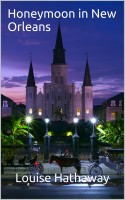
Our new book, "Honeymoon in New Orleans", is a travelogue/romance novel about our most visited and favorite city in America. Come along with our fictional characters Don and Isabella as they discover the wonders of New Orleans on their honeymoon. Learn about our favorite romantic spots, best places to eat, and best places to visit. This travelogue also includes helpful websites to consider before planning your next vacation.
This eBook is available at most online bookstores for $1.99:
Sunday, July 6, 2014
Smashwords Promo
Smashwords is having a promo this month and many writers are offering deep discounts. Do you like murder mysteries? Travelogues? Romance Novels? Literary Criticism? Chick Lit? Then check out the books of Louise Hathaway. We're offering 50% off.
https://www.smashwords.com/books/view/406383
Just use coupon code SSW50 under the "buy" button at check out and you're all set.
Friday, July 4, 2014
Do you like romance novels?
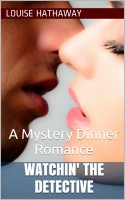
Have you ever been to a murder mystery dinner? My husband and I went to one and loved it. Afterwards, we asked ourselves, "What if a real murder happened during one of these performances?" That was our inspiration to write this novel. We've also been watching a lot of "Mad Men" lately, so we decided to have our two lovers look like Don Draper and Joan from the show.
The eBook is only $2.99
The Paperback is only $7.59
Saturday, June 28, 2014
Punctuation Can Be Fun
Many times when I've told people that I was an
English Major, I am answered by a groan and someone saying, “I hated that class
in school.” Why? They often answer, “Too much memorization of
stupid rules.” I’d like to stick up for
those “stupid rules”: I think that they are important because misuse of
punctuation marks can lead to confusion; and isn't writing ultimately about
communicating, not confusing? Here’s the
best description of the importance of these rules: “Punctuation marks are the traffic signals of
language: they tell us to slow down, take notice, or stop.” This quote is taken from Lynne Truss’s book, “Eats,
Shoots and Leaves.” She provides
several funny examples of misused punctuation.
Consider her title. It was taken
from a sentence she had read that was presumably was about the eating habits of
pandas; but the way it’s written, it makes you think that the panda had a gun:
he ate his food, shot his gun, and then walked away. Obviously, that’s not what the writer
intended and there shouldn't be a comma in his description. Frank McCourt, the noted writer and humorist,
said that Lynne Truss should be nominated for sainthood; and he should know
about the need for rules about punctuation: he taught English and most likely saw
several examples of bad writing over the years.
Here’s a funny example from her book about the
misuse of apostrophes: she had seen a sign about a large play area for kids
that said: “Giant Kid’s Playground.”
Would you want your child playing with the kid of a giant? I sure wouldn't.
Do you overuse exclamation points in your
writing? Truss quotes F. Scott
Fitzgerald’s description of them. He
says, “An exclamation mark is like laughing at your own joke.” She says that they are “like a big
attention-deficit brother who gets over excited, breaks things, and laughs too
loudly.” This is definitely something we
should keep in mind in our writing. I do not want to over-use them.
I write books with my husband and he’s asked me for
help in knowing where he should use commas.
I tell him to imagine saying a sentence out loud, and whenever you
pause, you probably will need a comma or some other punctuation mark. Like Lynne Truss says, “they tell us when to
slow down.”
Have you ever wondered when you should use a
colon? Here’s her rule: “they deliver
the goods that have been invoiced by the preceding words.” I use colons a lot in my writing and I love
this rule. Here’s an example she uses
for the correct way to use colons: in “The Hound of Baskerville”, Sherlock
Holmes says, “This much is clear Watson: it was the baying of an enormous
hound.” The writer should imagine saying
a delighted and satisfying, “Yes”, where the colon comes. Colons are nearly always preceded by a complete
sentence and are used to precede lists.
When should you use semi-colons?
They are used to combine two related complete sentences when there is no
conjunction (and, or, nor, but).
I wonder if someday soon, because of text messaging
and Twitter, things like good grammar, spelling, and punctuation will be seen
as a dying art; like using a fountain pen and going to the post office to buy
commemorative stamps to mail your correspondence and cards. In my own fiction writing, I use a lot of
sentence fragments because I think they make the paragraph more dramatic; so,
there is a time and place to bend the rules; but I liked to think that when I
read articles from Time Magazine or Smithsonian, the writers will continue to use sentences that deliver the goods and tell me when to slow down, take
notice, or stop. I have to admit,
though, that misuse of punctuation marks can lead to some hilarious and
unintended meanings which are always fun to catch.
Subscribe to:
Posts (Atom)